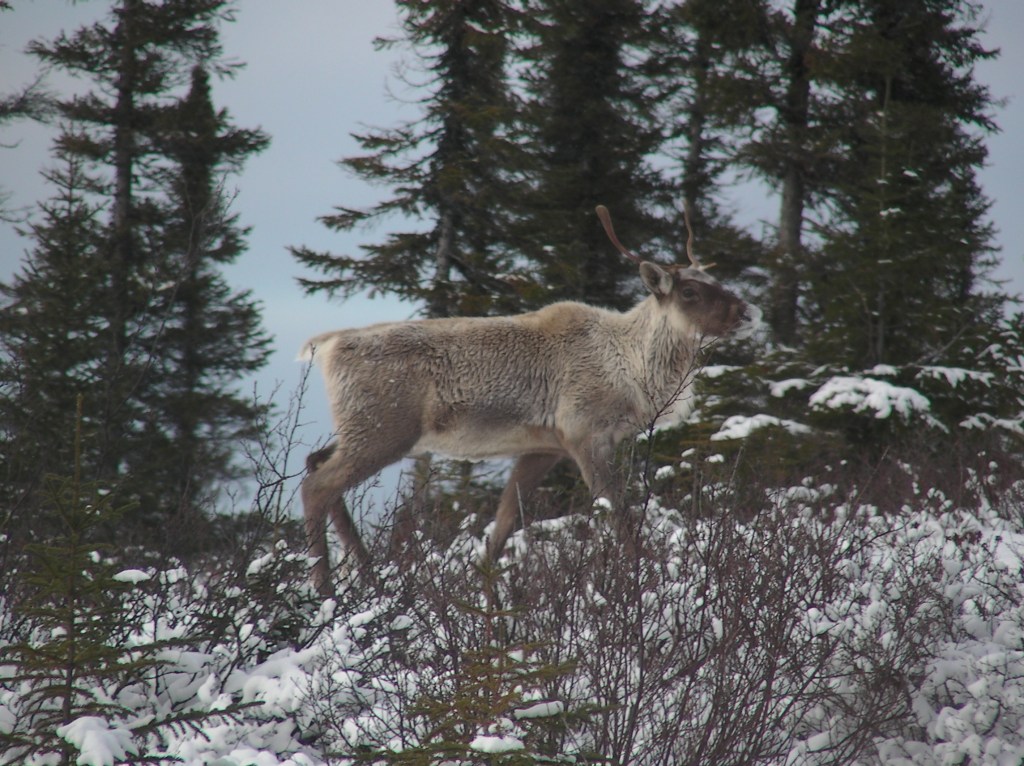
The brain worms killed the caribou.
That is what I went into my interview with Martin-Hugues St-Laurent hoping to hear. I had done some research on the Gaspésie-Atlantic Caribou for my upcoming book on endangered species, and I had been having a hard time tracking down concrete details on how, exactly, the caribou had become extirpated from the Maritimes.
The Gaspésie-Atlantic Caribou are currently only found on the Gaspé peninsula in Quebec, although they had once been common in Nova Scotia, New Brunswick, and PEI as well. Many of the sources I had found couched their explanation of the caribou’s disappearance from the Maritimes in “ifs” and “perhapses.”
“They were here, and now they’re not,” Andrew Hebda, curator of zoology with Nova Scotia’s Museum of Natural History told journalist Zack Metcalf in 2019.
“Everybody back then seems to have spent all of their time putting roofs over their heads and food in their mouths. There’s very little pre-20th century information on caribou distribution, habitat use or anything like that.”
I had hoped St-Laurent, as one of the leading experts on the Gaspésie caribou, could help me firm up what had happened.
He passed along a 1989 paper which I hope will give me the answers I am seeking. (I’ll admit, I still need to read it fully.) But our interview also gave me many more intriguing nuggets of information: details on the genetic drift between caribou sub-species, a discussion on the ethics of captivity for wild animals, and the socio-economic challenges of preserving caribou habitat.
You can read our full interview below.
Grace Kennedy: First things first, I’ve had a lot of difficulty finding out exactly how the Gaspésie-Atlantic Caribou became extirpated from the Maritimes. Do you have some background on what factors really led to that?
Martin-Hugues St-Laurent: Several factors with, I would say probably some synergistic influence. So, over harvesting for sure. Habitat disturbance, but also a couple of problems with the brain worm that were transferred from other cervids like white tail deer. I have all that in one paper published by Bergerud and Mercer. I think I’m gonna send this scientific paper to you, Grace Kennedy.
GK: Awesome. That would be super helpful.
So now I had read that Quebec is starting to implement some new conservation measures including partial captivity. Does that mean maternity pens for this caribou? What does that look like today?
MHSL: Actually in the Gaspésie population, they have two enclosures. So two pens. They’re supposed to be maternity pens. So females are captured in the middle of the pregnancy and brought to the pen in two different areas because the population in Gaspésie is actually divided into two subpopulations, determined on a genetic basis, because of the lack of exchange of genes between the west and the east of the distribution range of the population. So there’s two pens.
They were supposed to be only there for a few months to capture in, let’s say probably February brought to the pen, fed ad libitum. And females were supposed to give birth in the pen and then should be released in August, September when the calf is strong enough and fast enough to avoid and escape predators.
But they lived out for the first year, but this year they decided to keep all the caribou in an enclosure. So it’s not a matter of intermittent penning anymore. It’s permanent penning like in the Val d’Or and the Charlevoix region.
GK: And what do you think the outcome of that is going to be going forward. Is that going to be a net positive or?
MHSL: I think so because, as long as you’ve not solved the problems that brought caribou to the decline in the wild, like in the Gaspésie region where you have an increased predation pressure on calves that is triggered by the habitat disturbance.
So as long as you’re only trying to fix the proximal factors, like there’s too many coyotes, they’re too many bears. There’s too many roads to have those animals efficient at hunting caribou. As long as you’re not taking care of the habitat disturbance level, you will always be facing the same problem.
So releasing the animals from the pens, you will bring more meat to those predators and you should have the same results.
So animals are a little bit more naive because they grew up in a pen and they are released and they die. So keeping them in the pen while trying to fix the ultimate factor of the climate, which is currently a disturbance problem, is a suitable and I would say scientifically supported idea. But it raises some ethical concerns.
Are they wild animal anymore? Are they penned animals, like what we have in the zoo? So we can question all that. But let’s keep it pragmatic. If we are pragmatic, we know that those animals are gonna die outside of the pen despite all the effort that we’ve invested in predator controls—because we are doing predator control since 2019 in the park.
So we’re removing, I don’t want to say tons, but we’re removing many, many coyotes and bears every year. And despite those efforts, we still have a declining population.
So, I cannot necessarily share with you the new numbers we have because they’re not, they’re not public yet. But I can testify that it’s working. The penning experiment is working.
GK: Well, that is really good to know. And last year was the first year that the penning started, right?
MHSL: It started, let’s remember, I think it started two years ago. Yes, I think it’s gonna be the third winter.
GK: It’s good enough for a kids book.
Another question is that I’m having a section at the back with what can kids do to help endangered animals. Obviously, there’s not tons that they can do to help habitat disturbance or the Gaspésie caribou. But are there things that you would recommend that younger people could do to help endangered animals more generally, or caribou more generally?
MHSL: The first thing I would say, we’re usually keen to protect what we love, and we love what we know. So, I think that making sure that the kids understand how precious the living organisms are and, and, and the hurt is it’s the sole own that we have.
We should probably try to take care a little bit more of that wilderness and natural environments. Sharing the importance of nature with their parents, with their uncles, with their family, with their cousins.
It’s also important, keeping the eyes of the children away from an iPad and bringing them into the wild, bringing them in nature for a hike or ski or snowshoeing or—it’s always good way to realize the benefits of living in nature.
And then because those kids will grow up and, and then will vote and will be citizens and maybe decision makers later to have this small seed of the importance of nature growing into their mind is important.
So for the kids, I would say try to be a good ambassador of nature, for the close relatives that you have. If you can convince only one person, then within a few years you’ll be all together supporting nature.
But I know that they cannot necessarily jump into the debate of all of their socio-economic losses associated with the protection of caribou habitat. And I’m gonna find a way to solve that—we’re a bunch of researchers trying to find a way to get out of the mud. But it’s a matter of political courage for now.
So the kids, they have to keep dreaming and explaining to all the persons around them why they love that because we’re going to take care of what we love and we love what we know. So if they know nature because they are used to going out [in it]. If they enjoy nature, they will protect nature. Not only the caribou.
GK: That’s a lovely way to put it. Just two more questions and hopefully we’ll get you out of here early with a little bit of breather time. So morphological differences between the Gaspésie caribou and other types of caribou: are there differences in the way they look or the way they act like from other caribou specifically?
MHSL: Have you read the COSEWIC report regarding the designable units?
GK: Yeah, I had looked over that.
MHSL: So there’s five different criteria that can be used to define a group of caribou as a designable unit. And the smallest designable unit, the smallest DU that we have in Canada is the Gaspésie caribou population.
Those different criteria, the first one is the disruption of the species range, you also have the phylogenetic, you also have the difference in the genetic signature, you have the behavior and the morphology.
So the caribou in Gaspésie are a bit, I would say, taller, maybe a little bit bigger than what we have in Northern Quebec or in Northwestern Canada, for example. They have different colors, a little bit more darker, I would say or maybe a little bit more contrast between the fur and you know, the color.
And they are of a totally different—not totally different because they are still the same species, but they have a quite different genetic signature because they cannot exchange genes with other caribou in the world since probably more than three centuries.
If they want to meet another caribou, except going into a zoo, what they have to do is to cross the Saint Lawrence River in Quebec City using the bridge where there’s a tons of traffic and, and there’s probably no caribou lane, or to take a boat in eastern Quebec to cross 60 kilometers of open water. So there is no chance that they’re gonna see another caribou.
So since probably more than I would say, two, three centuries, there’s a genetic drift, OK? A kind of divergence of the signature because they are concentrated together a little bit more cons a little bit more of in breeding ok, not necessarily totally problematic but we have some concerns regarding genetics of that population.
The p genetic line from the last millennia, it is also different. Have you ever watched the animation movie called Ice Age? I have two kids so I probably saw that film several times, but we have those animals going south to avoid the thick ice and a lot of snow when we cross the last ice age. And then we have a massive amount of ice and snow that brought the caribou down south and split them into two groups, one near Pennsylvania and the other one between Alaska and Russia, what we call the Bering Strait.
And when the ice melts and the temperature rises a little bit, those two groups recolonized Canada. So the Gaspésie population belongs to the group of animals that were on the east shore of the United States, while the caribou we have in Alberta, for example, are from Alaska.
So that’s the phylogenetic line, which is a bit, maybe too, too complicated for your kids.
GK: But really interesting.
MHSL: So yes, the caribou at Gaspésie are a little bit different genetically speaking, behaviorally, morphologically, but they’re still caribou.
So reindeer in Europe and Asia, caribou in North America and, and Santa Claus reindeer, that’s exactly the same species.
GK: Perfect. And then the last question is, what is your favorite fun fact about caribou?
MHSL: You know, I’m a scientist studying caribou since 20 years now. So I don’t know if it’s really funny, but caribou are the only cervid species with antlers for both males and females. And there’s a reason for that.
Caribou are living on the fringe of, you know, minimal amount of food. They are in an environment where there’s not that much food. So it’s hard for them to have access to enough energy and proteins to grow up, especially if you want to produce kids.
I remember when my wife was pregnant with the two kids we have now she was eating a lot. It was crazy. Because it’s costly to produce a baby, costly to feed a baby with milk. It’s very costly. So imagine if you do not have access to a fridge.
So evolutionary speaking, there’s an advantage for the female to have very short antlers. While all of the females of other cervids, they do not have answers. White deer, moose elk: they do not have antlers, only for males.
So they are very short. Very robust. And they use that at the end of winter because the males will use their very large antlers to fight with other males and have access to the females and show that the females ‘Look how strong I am. I’m gonna be your man.’
But then shortly after the rut period, the males will lose their antlers.And there’s only those females with small antlers that left. And then the snow accumulates on the ground and above a meter of snow, it’s very costly to dig into the snow to access the vegetation on the ground. So what will female do? Because they are pregnant. They cannot lose too much energy.
They will let the males dig and when the male will reach the ground and start feeding, they will jump into the crater and poke the males with their small antlers and the males will just leave the crater.
The female will eat and the male will start digging somewhere else because this job is done, they are already pregnant. And they will just jump from craters to craters to feed.
So that’s a very interesting fun fact linked to the evolutionary ecology because there’s an advantage of keeping that for females that is really cool.
They will lose their antlers later. When the spring comes, and the snow starts to melt, then the access to the vegetation is easy. They do not have to dig anymore, or not that much. They are at the end of their pregnancy, because they will give birth between mid-May and mid-June.
So it’s costly from the pregnancy perspective, but they have access without too much energy expense to the vegetation. So that’s a fun fact.

 Grace Kennedy
Leave a comment