Province of Nova Scotia Scholarship – Atlantic Journalism Awards, 2016
This article was written for the Narrative Non-Fiction course at the University of King’s College. The full text can be found below.
“Cold Awakenings”
It was the first warm day of 2013. The sun had been making its way over the gypsum cliffs outside South Maitland for several hours, and wind blew through the leafless trees along Five Mile River.
Biologist Hugh Broders and his student Jordi Segers were wearing hip waders, trudging across the river on their way to Hayes Cave – the largest site of hibernating bats in Nova Scotia. There should have been 17,000 bats inside the cave, their hearts beating once every 12 seconds. Broders and Segers climbed the slope of rubble to the entrance; they picked up 20 dead bats on their way, more were flying overhead. Something was wrong.
They stopped at the crack in the cliff. Broders pulled a disposable Tyvek suit over his jeans and sweater; he had already changed into rubber boots. He put on his hardhat and headlamp, grabbed a tally counter, and squeezed through the entrance.
Inside, the cavern was 20 metres across and 20 metres high. The air was still; the only sound was the rapid plinks of falling water. Broders’ headlamp illuminated the columns of ice near the entrance of the cave. Among them were hundreds of dead bats.
He sat on the cold, slippery rock, waiting for Segers to slide down the small slope to the cavern. He knew it was coming – he had started doing these winter counts six years before to prepare for the mass exterminations making their way across the northeast. But that didn’t make it easy to see.
“Unfortunately I wasn’t surprised,” he said. “It wasn’t like ‘Oh my god what’s going on here’. I knew it was coming, so I was sort of prepared for it. Still incredibly saddened to see it right in front of you.”
They didn’t do the count that year. They didn’t have to.
Broders and Segers collected 200 dead bats; a month later, they collected 300 more. By the next winter, more than 16,000 bats had died in Hayes Cave –now, no more than 300 hibernate there. There are even fewer in the rest of Nova Scotia’s caves and mines, and it’s all because of a tiny, cold-loving, globe-trotting fungus.
Pseudogymnoascus destructans, more commonly called Pd, is an invader from Europe, likely brought over in the dirt on someone’s boots or backpack. In Europe, it’s just another fungus –scientists don’t fully understand why.In North America, it has decimated bat populations.Named for the characteristic fuzzy nose infected bats often develop, white nose syndrome makes hibernating bats wake up when they shouldn’t. Unable to replenish their fat reserves, they die of starvation, dehydration and hypothermia.
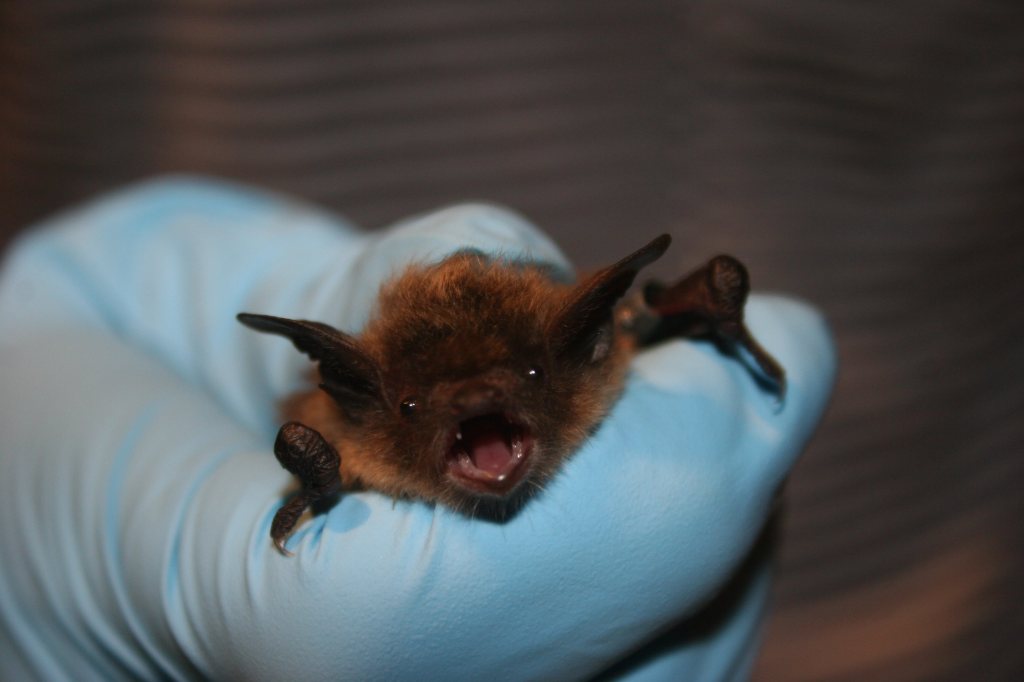
White nose syndrome was first documented in Albany, New York in 2006. Since then, it has spread halfway across the continent –officially killing 6.7 million bats. Seven different bat species have been affected by white nose syndrome, including three of Nova Scotia’s six species: the northern long-eared bat, the tri-coloured bat and the little brown bat.
Hugh Broders had studied these bats for more than a decade. The plaque outside his Saint Mary’s University office identifies him as: Dr. Hugh Broders, Biology Professor, BATMAN. He has a batman lunchbox and hanging bat decorations in his lab, and he looks a little like a bat too – one canine tooth is slightly pointed, and his close-cropped hair is the same frosted colour as the fur of a hoary bat.
After the first outbreak, Broders held a meeting with other Atlantic Canadian bat biologists. “We said, we’ve really got to get a good handle on what we have here, so that if this thing comes we’ll at least know what we’ve lost.”
They started counting Nova Scotia’s hibernating bats twice a year, and continued researching bats that roosted in the province over the summer.
By the following winter, the disease had spread to 14 more American counties; by 2009, it had reached Ontario and Quebec. In 2010, it was on both sides of the Bay of Fundy.
Now, nearly all of Nova Scotia’s hibernating bats are dead. Broders had hoped to learn more about how experience influences a bat’s social life through these populations – not just to document the “average bat.” He wanted to know how bats relate to each other.
And so for him, it’s not the numbers that make white nose syndrome an unprecedented tragedy. It’s the individuals.
“You have these animals getting infected with this foreign fungus, waking up, staying awake longer, starving, freezing cold,” Broders said, sitting at his desk in the university. “These are long lived, highly social, very sentient beings. The amount of pain and suffering they must have had would truly be immense.
“Most people don’t respect it, right. They see a bat; they think it’s just a bat …. These animals are cognitively complex. They’re not simple organisms. And I have no doubt that they experience pain just like we experience pain and frustration and all those things.
“And now what I think about sadly is this animal right here,”Broders looked at his computer screen, a picture of the last bat at Rawdon frozen in a PowerPoint. Broders had gone into the abandoned mine in April 2014 for a winter count. There was only one bat there. “It could be a female,” he continued. “And let’s say that female could be 22 or 23 years old. Every year it could come to that place to hibernate. And every year it goes there, and there’s 1200 bats there.”
Every spring she leaves and flies to her summer roost – maybe to someone’s attic a kilometre away, or to a tree one hundred kilometres away. Every night, she soars out over a lake to feed on fat moths, scooping them up in her tail membrane. When she returns, she is surrounded by 500 other pregnant bats; her mother, sisters, aunts, cousins, daughters, strangers. They give birth to one pup each and raise them in the roost.
In fall she flies back to the hibernaculum, mingling and mating with thousands of bats from miles around. And by October she has settled back down, flying across 50 metres of water to hang from the grey slate walls. She is all alone.
In April 2014, when Broders climbed and slid over several feet of ice to count the bats, she had white fuzz on her wings.
The next year, the mine was empty.
White nose syndrome is not a pleasant way to die. It forces bats to wake up from hibernation – a state closer to suspended animation than to sleep.
During hibernation, a bat’s body temperature can go down to four degrees. Their metabolism nearly halts: their heart rate slows dramatically and they exhale once an hour. Their immune systems are suppressed. Possibly other systems are suppressed too – Broders suggested hibernating bats may be incapable of digestion – but scientists can’t say for sure.
The bats normally wake up once every 15 or 20 days to drink, pee, mate, groom and possibly sleep. But each arousal comes at a cost. Bats only have a few grams of fat to get them through eight months of hibernation – waking up uses about 100 milligrams of that fat, which could get them through another two months. The more often they wake up, the less fuel they have to see them through the winter.
Pd grows on the bat’s exposed skin: the nose, wing membrane and tail. The nose, as the disease’s name suggests, usually sports the most fungal growth. However the wings, which make up about 85 per cent of a bat’s total surface area, are the most vulnerable during an attack.
Like most fungi, Pd has a stalk called a hypha which grows and spreads across the skin’s surface. Eventually, when the fungus has grown enough, it produces squat, banana-shaped seeds called conidia. These conidia drop off the fungus and contaminate new areas – one seed on a bat will infect it, one seed in the soil can survive for at least a decade.
Under a microscope, a stain details the fungus. It’s bright pink hyphae pool on the skin and around turquoise hair follicles; the curved conidia assemble around the stalks. The fungus can grow so much it causes the skin to change shape, creating a pocket called an erosion. When it breaks through the layer of skin cells, the erosion becomes a burning ulcer. If left unchecked, it continues to spill throughout the wing membrane, replacing connective tissue.
Scientists don’t know exactly how white nose syndrome makes bats leave hibernation, but whatever the reason, infected bats wake up nearly five times more often than healthy bats. This increase in arousal creates a cascade effect among other bats: easily disturbed by sounds, light, or movement, as one bat wakes up, so do many others. This is why biologists are asking people not to go into caves. Not only can we spread the fungus to new areas, but we could accidentally disturb bats already stressed by white nose syndrome.
By January, it is too late for many infected bats. When they die is usually determined by the size of their fat reserves, but all will reach the same end. Dehydrated and starving, the bats wake up permanently. Some die in the mouths of their caves or mines. Others crawl out in the snow, shivering, eating pine needles in a desperate attempt to feed. Others fly out in broad daylight until they die somewhere in the landscape.
And when someone finds them, they’re shipped to Scott McBurney.
McBurney is a wildlife pathologist at the Canadian Wildlife Health Cooperative (CWHC); he has worked on everything from whales to loons to bears, and in a year he will typically see between 600 and 800 animals go through his Charlottetown lab. Because of white nose syndrome, around 100 of those animals are bats.
In the lab’s cold storage room, animals are thawing. A black and white baby goat is sprawled on the red-painted floor; other, smaller animals are on metal shelves. On one of those shelves, close to the industrial refrigerator door, are four tiny bats.
Double bagged in Ziplocs, and identified with luggage tags, these bats had been in McBurney’s lab since last April. McBurney and Broder’s former student Jordi Segers – now the national white nose syndrome coordinator at the CWHC – were waiting for funding to test Canadian disinfectants on Pd before necropsying these bats, but it didn’t come through. They went ahead anyway, disinfecting the stainless steel table with bleach and a DNA destroying chemical.
McBurney and Segers sat across from each other, white cutting boards in front of them. The bats, their wings tucked tightly beside their fuzzy bodies, were in disposable dishes, waiting to be weighed on the electronic scale. McBurney did his bat first: 4.6 grams. Segers’ was almost twice as heavy, but it was also wet, it’s dark brown and yellow-tipped fur pasted against its skin.
They worked at the same time, slicing, crunching, sniping and swabbing overtop scattered conversation. McBurney swabbed his bat’s wings, tail and nose for fungus; the edges closest to its armpit were wrinkled in a characteristic sign of white nose syndrome. They wiped each bat with a thinner swab inside their miniscule mouths and anus for avian influenza.
“Scott always tells me that I forget that they’re dead,” Segers said. He is originally from the Netherlands – he did his undergrad there – and he carries a Dutch accent. “I’ve held so many live bats that I cradle them and are very careful. I guess that’s also showing respect, but it’s not the easiest to get to all the surfaces that way.”
The next steps in the necropsy were more invasive: Segers and McBurney clipped a section of each wing for the petri dishes. Then, using a scalpel, they outlined the edges of the bones and removed nearly all the skin from the wings and tail. McBurney balled the skin between his gloved fingers, cells and pigment rubbing off on him.
Then, the part that always made Segers cringe: using the scalpel to chop off the bat’s nose, and chopping again several millimeters behind that. There was a sharp crunching noise as the blade crushed through the thin bones, pointed teeth and cartilage.
The skin and nose pieces went into a small plastic cage – histologists at the Atlantic Veterinary College would later turn them into microscope slides. McBurney and Segers separated other parts of the tiny animals: an ear for one researcher, the feet and thumbs for another. Each went into its own vial of preservatives.
Next, they slit open the skin along the chest, the thick smell of decaying organs becoming stronger. There was no fat under the skin, just prominent pectoral muscles. Beneath that, McBurney sliced out the heart, lungs, uterus, kidneys, intestines and stomach. They were impossibly minute – the heart was smaller than an Advil, and it was a moist, jewel-toned red. All these organs went into another plastic cage, also to be turned into slides.
Finally, McBurney slid the skin and fur from the bat’s skull. He cracked around it’s edge, making a cap no bigger than a pinky fingernail. Beneath it was the light red brain, a wet bobble of tissue cradled inside the skull. He scooped it out, cut it down the middle and put one half of the brain into a tube: later it would be tested for rabies.
The necropsy now over, Segers and McBurney placed their bat carcasses into plastic bags. They put their gloves and scalpel blades in the garbage – it would be incinerated later to prevent the spread of Pd – and rinsed the equipment. Then, it was doused in bleach and DNA destroyer, disinfected for the next two bats.
“This is now an endangered species,” McBurney said, preparing the equipment. “The more we can get out of this tragic event, the more we can do for bats by examining these carcasses, the more helpful we can potentially be over time.”
Cognitively complex. Highly social. Long-lived. This is how Hugh Broders would describe the four bats that found their way to McBurney’s lab. Those words form the basis of his big question: what does bat culture look like?
The answer is, we don’t know – or perhaps more accurately, we don’t know all of it.
Broders set up a long term study at Rawdon’s abandoned gold mine in 2004. He wanted to find a summer colony of mothers and pups, tag those animals using microchips, and see if they hibernated together. None of those bats showed up at Rawdon.
Hugh Broders is the type of scientist who will carry four car batteries through several feet of snow so he can get to his bat detectors more efficiently. When the icy marsh outside Hayes Cave wouldn’t support his weight, he ran straight at it and slid across. And so, when the bats didn’t show up at his mine, he adapted. He tagged bats that did hibernate a Rawdon to see if they came back every year. Most of them did.
Then, white nose syndrome. Just before the disease reached the Bay of Fundy, “I started thinking to myself, ‘This is coming here’,” he said. “It’s probably going to wipe a lot of stuff out.” In 2011, he started doing research in Newfoundland.
Hopefully, on that cold rocky island, bats will outlast the disease. Because it is an island, other bats might not hazard the long ocean journey to hibernate there. If humans are rigorous in preventing the fungus’ spread – Broders doesn’t bring any equipment from Nova Scotia into Newfoundland: “I need to be able to rest easy that we didn’t cause (the spread)”– it’s possible bats can survive.
Broders and his students have documented some of the ways Newfoundland bats interact. They greet each other by rubbing noses. They groom themselves like jerky little dogs, and groom their pups too. Occasionally, one bat will bite or chase another – possibly two juveniles playing together. They spend the day lit hours sleeping, but also chatting to each other: hundreds of squeaky, scratchy voices chirping discordantly.
Broders has 1.5 million records of where every tagged bat roosted over four years. He is currently processing that data, finding out which bats were in the same roost at the same time and seeing if they moved to new roosts together. When he’s through, there will be a clearer picture of what a bat society looks like.
Whatever that picture is, Nova Scotia has lost it. It will likely take hundreds of years for Nova Scotia’s bats to reach the numbers they once had – bats only give birth to one pup a year – but with so many bats gone, so many colonies destroyed, it may be impossible for their culture to survive.
“We may get little brown bats back,” Broders said. “And you and I, we might not be able to tell the difference if there’s bats. But I think the fabric of that entity that we call a bat population is going to be very different.”
The female bats Broders used to study roosted in colonies hundreds strong; the ones in Newfoundland still do. These numbers are biologically important – more bats mean more shared body heat – but they are also important to bats’ mysterious social lives.
We don’t know if single mothers will be able to raise their pups alone. We don’t know what bats are saying when they are chattering to each other during the day; we don’t know why they rub noses. We don’t know how they find new roosts and whether they tell others where to find food. We don’t know how the surviving bats will be able to continue their lives.
“Those individuals that are left could be perfectly healthy,” Broders said, “but their ability to carry on a normal – a normal in quotation marks –life for a bat is pretty much shot because the social fabric of its existence is gone.
“And so we talk now about the population being able to rebound, and we all hope that it does.” His voice was plaintive and earnest. “But what comes back in the end?”


Leave a Reply